author
Bobby Brown
更新 2026-07-08
How Do Ultrasonic Flow Meters Work? The Transit-Time Principle Explained

Contents


Why Non-Invasive Flow Measurement Matters

An ultrasonic flow meter is a device that measures liquid flow using sound waves instead of moving parts. The clamp-on type is a common one you'll find in the market, and for good reason: its non-invasive installation makes it easier and faster to install and lower-risk to run. Non-invasive means the sensor mounts to the outside of an existing pipe and reads flow without ever cutting into it — unlike traditional in-line flowmeters, which need to become part of the pipe: shutting the line down, cutting it open, inserting the sensor, and sealing it back up. Clamp-on ultrasonic meters skip all of that entirely.[1]

That lack of contact matters just as much as the time saved: because the sensor never touches the liquid inside, there's no contamination or corrosion risk, and nothing added to the flow path to cause a pressure drop. No pipe cutting also means no new joint that can leak later. Put together, the bigger win isn't just a faster install — it's a sensor that adds zero risk to a line that's already running. Understanding how that's possible starts with one simple idea.

Traditional In-Line
Traditional in-line flowmeter icon
Pipe cut open,
line shut down to install
No
Clamp-On Ultrasonic
Clamp-on ultrasonic flowmeter icon
Straps onto the outside,
pipe keeps running
Yes

The Core Idea Behind Every Ultrasonic Flow Meter

Sound travels slightly faster when it's moving with the flow, and slightly slower when it's moving against it. Send a pulse of sound in each direction along the same path, and the difference in how long each one takes to arrive tells you how fast the liquid itself is moving.

That's the whole idea — everything else, the transducers, the electronics, the readout, exists just to measure that tiny time difference precisely enough to turn it into a usable number. This is called the transit-time principle — the most applied method for ultrasonic flow measurement today.[3] Here's what that looks like in practice.


Transit-Time Measurement: How It Works, Step by Step

A transit-time ultrasonic flow meter uses two transducers mounted on the pipe, one upstream and one downstream of the other. Each transducer can both send and receive an ultrasonic pulse.

Here's the sequence:

  1. Transducer A sends a pulse downstream (with the flow direction). Transducer B sends a pulse upstream (against the flow), either at the same time or in close succession.
  2. The downstream pulse arrives slightly faster. The upstream pulse arrives slightly slower.
  3. The meter measures this time difference — usually a matter of nanoseconds — between the two.
  4. That time difference is directly proportional to the liquid's velocity in the pipe.
  5. Velocity multiplied by the pipe's cross-sectional area gives the volumetric flow rate.
Transit-time (Time-of-Flight) principle
Δt (time difference) → v (velocity) → Q = v × A (flow rate)

Where A is the pipe's internal cross-sectional area. The meter already knows the pipe's dimensions (entered manually or, on newer meters, detected automatically), so once it has Δt, the rest is calculation, not guesswork.


Why Sound Can Measure Flow From Outside the Pipe

Sound doesn't stop at the pipe wall — it passes through solid metal or plastic and into the liquid, then back out the other side. That's the physical basis for clamp-on measurement: the transducers don't need to touch the liquid, or even breach the pipe, because the pipe wall doesn't block the signal — it becomes part of the path the sound travels through instead.

This is also why clamp-on meters have no wetted parts. There's nothing inside the pipe to wear down, corrode, or restrict flow.


What Transit-Time Meters Need to Work Well

Transit-time measurement depends on the sound pulse actually making it across the pipe and back in a clean, readable form. That means it works best on liquids that are relatively homogenous and free of heavy particulates or excessive entrained air — conditions that scatter or absorb the signal instead of letting it pass through cleanly. This isn't a flaw so much as a defining characteristic of the technology, and it's the reason transit-time and Doppler ultrasonic meters exist as two different approaches.


Transit-Time vs. Doppler: What's the Difference?

Doppler ultrasonic meters work on a different mechanism: they bounce sound off particles or bubbles suspended in the liquid and measure the frequency shift of the reflection.[2] That makes Doppler meters useful for slurries or liquids with entrained solids — but they need those particles to function at all.

Transit-time meters need the opposite condition: a relatively clean liquid the sound can pass straight through. Neither approach is "better" in general — they're suited to different liquids. (We cover this comparison in more depth in a separate article on choosing between transit-time and Doppler meters.)


What Affects Ultrasonic Flow Meter Accuracy

Because the whole measurement rests on timing a signal precisely, a few real-world factors can throw it off:

  • Pipe material and wall condition. Sound travel through the wall depends on knowing the exact material and thickness. Corrosion, scaling, or an incorrect pipe spec entered at setup all introduce error.
  • Liquid homogeneity. Excessive entrained air or suspended solids can scatter the signal enough to disrupt a clean transit-time reading.
  • Straight pipe run. Ultrasonic meters generally need an unobstructed straight length of pipe upstream and downstream of the sensor — commonly at least 10 pipe diameters upstream and 5 downstream, extending to 15–20 diameters or more after a nearby bend, valve, or pump[4] — so the flow profile isn't distorted when the reading is taken. Multi-path meters, which average several acoustic paths at once, are less sensitive to this than single-path meters.[3]
  • Installation precision. Transducer spacing and alignment need to match the pipe's actual dimensions closely. A few millimeters of misalignment changes the sound path length, which changes the math.
  • Temperature. Sound speed in a liquid shifts with temperature, so meters need to account for it rather than assume a fixed value.

Most of these come down to one thing: how well the meter's setup matches the pipe's actual, physical reality. Manual pipe-spec entry is one of the most common places for that mismatch to happen.


Where Ultrasonic Flow Meters Work Best

Transit-time ultrasonic meters are a strong fit for relatively clean liquids: process water, purified and DI water, chemical solutions, and closed-loop water in HVAC and cooling systems. This covers a lot of ground in semiconductor and PCB manufacturing, wastewater treatment (post-solids-removal stages), car wash water reclamation loops, healthcare facility purified-water systems, and general industrial water loops.

For liquids that are inherently full of solids or bubbles by nature — raw sewage influent, slurries, some food-processing streams — Doppler or another flow measurement technology is often the more practical starting point.


How Ultrasonic Compares to Other Flow Meter Types

Ultrasonic meters usually cost more upfront than mechanical types like paddle wheel or turbine meters. What that extra cost buys is no moving parts to wear out, low maintenance, and — for the clamp-on type — the ability to install without cutting the pipe. Whether that trade-off is worth it depends on the application: for a deeper, side-by-side comparison against electromagnetic, Coriolis, differential pressure, and other flow meter technologies, see our flow meter selection guide.


From Principle to Product: FU-ES EchoSense in Practice

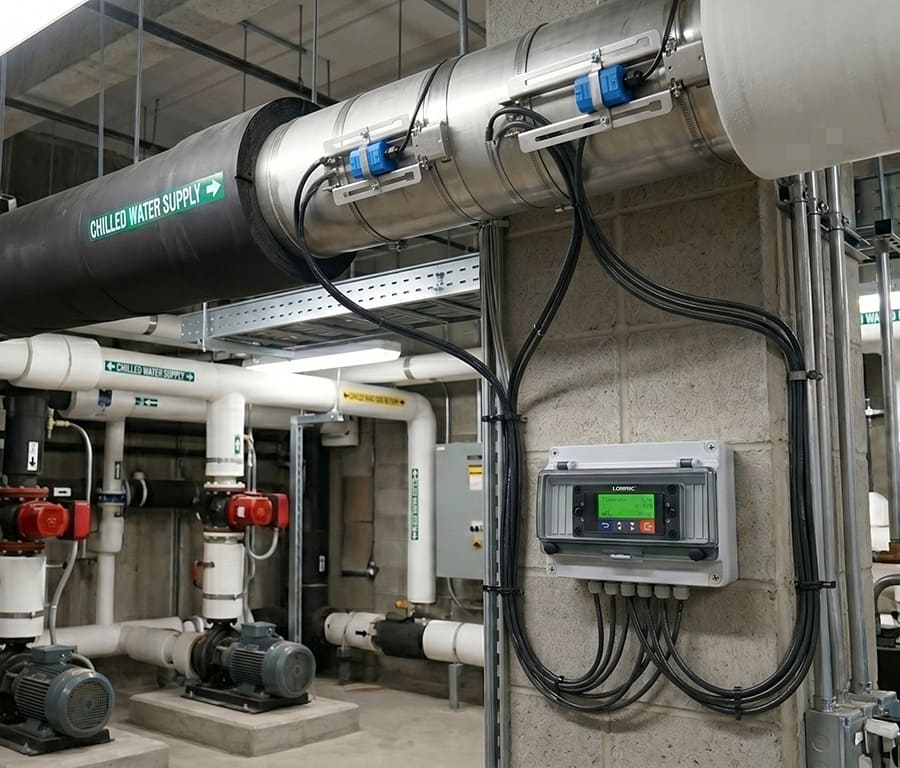
LORRIC FU-ES EchoSense clamp-on ultrasonic flow meter

Everything above — pipe-spec accuracy, installation alignment, straight-run requirements — is where the real-world error in ultrasonic flow measurement tends to originate, not in the underlying physics itself. LORRIC's FU-ES EchoSense clamp-on meter is built around closing exactly those gaps: one-click automatic pipe-spec detection removes manual entry error at setup, and a 3-minute clamp-on install (no pipe cutting, no ultrasonic gel — a gasket pad instead) makes it practical to install correctly the first time, without cutting corners under time pressure.

See the FU-ES EchoSense's full specs, accuracy rating, and install process.

Learn more about the FU-ES EchoSense →

Frequently Asked Questions (FAQ)

Why is my ultrasonic flow meter reading unstable or fluctuating?

An unstable reading is usually caused by air bubbles or particulates disrupting the signal, poor acoustic coupling between the transducer and pipe, or insufficient straight pipe run near the installation point. Checking signal strength and quality values on the meter's display is the fastest way to narrow down which of these is the actual cause.

How do I choose between inline and clamp-on ultrasonic flow meters?

The choice mostly comes down to installation constraints and precision needs. Clamp-on meters install without cutting the pipe or interrupting flow, making them the practical choice for existing lines. Inline (wetted) ultrasonic meters, which are installed as part of the pipe, can offer somewhat tighter accuracy in demanding applications, at the cost of the downtime and installation work clamp-on avoids.

Can ultrasonic flow meters measure gas?

Yes, but not with the same meter design used for liquid. Industrial ultrasonic meters built for gas — often multi-path, in-line configurations — are used for applications like natural gas pipeline metering. LORRIC's ultrasonic clamp-on line, including FU-ES, is designed and calibrated for liquid flow specifically.

Are ultrasonic flow meters expensive to maintain?

Generally no — since clamp-on ultrasonic meters have no moving parts and never contact the liquid inside the pipe, there's nothing inside to wear down or replace. Maintenance is mostly limited to periodic calibration checks rather than physical servicing.

Do ultrasonic flow meters need regular calibration?

Yes — like all flow meters, ultrasonic meters can drift slightly over time. Industry guidance generally recommends calibration checks about once a year under normal operating conditions, with more frequent checks (every 6–9 months) for critical or regulated applications.

你可能也會感興趣
相關文章

聯絡我們