author
Bobby Brown
Publicar 2024-03-25
How AxleSense Technology is Setting a New Standard in Flow Measurement

Abstract

  • Traditional paddle wheel meters: Include bearings prone to wear, making them better suited for clean fluids.
  • AxleSense flow meters: Feature a shaftless design, reducing wear and maintenance, ideal for dirty or particle-laden fluids. AxleSense offers longer lifespan and higher reliability, especially in demanding industrial environments.

Contents

For many years, impeller flow meters have been widely used across various industries due to their ease of installation, ability to measure in both parallel and perpendicular directions, a relatively large range of flow velocity measurement, and the accuracy of electronic flow meters at a more affordable price, making them a favorite among users.

However, LORRIC, with nearly 30 years of experience in fluid mechanics, has observed and collected feedback from thousands of customers. We've identified several areas where the widely used impeller flow meters can be improved to enhance the user experience.


1. Insights from Years of User Research Revealed the Following Drawbacks in Impeller Flow Meters

1 ) Low Sensitivity of Sensing Signals

Traditional impeller flow meters have four blades, each with a magnet, spaced 90 degrees apart, resulting in a signal every 90 degrees. This arrangement leads to insensitive signaling. Additionally, when the impeller is between two blades, the absence of magnetic induction means the machine cannot differentiate between no detection or the impeller being missing.

2 ) Flow Direction is Unknown

One characteristic of impeller flow meters is their ability to monitor flow speed in both directions. However, to determine the flow direction, one must install a flow viewer or use another method. This inconvenience may increase management costs for site managers.

3 ) Damage to the Impeller Flow Meter Leads to "Zero" Signal Output

When an impeller flow meter detects zero flow, it could be due to very low actual flow or no flow, or it could result from pump, pipeline, equipment faults, or impeller blade detachment and damage due to crystallization or wear. Traditional impeller flow meters cannot indicate whether a zero flow reading is caused by the former or the latter, presenting a significant instability factor in site management.

To reduce costs, some impeller flow meters use less expensive rare-earth magnets, resulting in one to two signals per rotation, further reducing signal sensitivity. Additionally, uneven weight distribution can cause uneven rotation speeds, affecting flow accuracy and lifespan.

LORRIC values customer feedback and maintains a rigorous standard for our products. To improve user experience, LORRIC's R&D team has developed an innovative patent design that addresses the shortcomings of traditional impeller flow meters, allowing for more accurate flow speed and volume measurement.


2. LORRIC's Patented "AxleSense" Technology Reinvents the Impeller Flow Meter:

AxleSense Technology

LORRIC has improved the sensing magnet placed on the blades, changing the measurement principle from the time difference as magnets pass by the sensor to the direction of blade rotation, creating "AxleSense blades." Coupled with LORRIC's redesigned flow algorithm, the patented "AxleSense" technology significantly enhances the ability to detect extremely low flows and provides real-time monitoring of blade anomalies.

1 ) Features of the Patented "AxleSense" Technology

➤ Broader flowrate detection range (0.15m/s~10m/s)
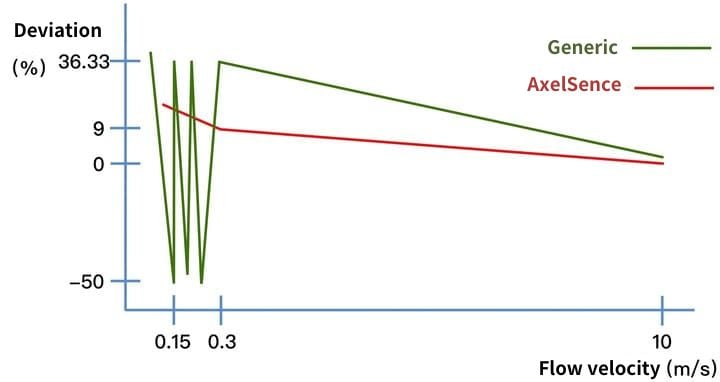
 Broader flowrate detection range

Traditional impeller flow meters, with sensing magnets on the blades, exhibit significant errors or even fail to detect at low fluid velocities in the pipe. As shown in the left graph, at speeds below 0.3 m/s, detection becomes difficult, with errors reaching 36.33% of the reading. Below 0.3 m/s, errors dramatically increase to over 50%, making the data several times different from actual figures and unusable.
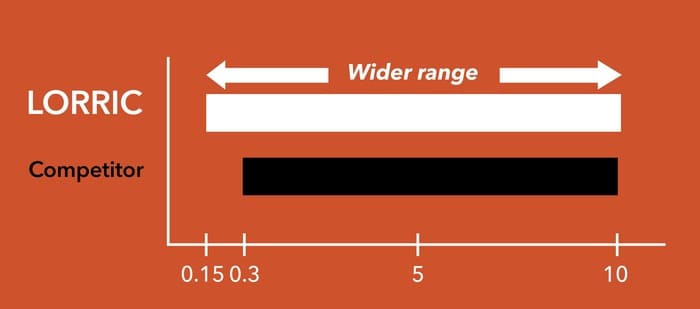
LORRIC vs Competitor

Conversely, LORRIC's impeller flow meters, using the patented "AxleSense" technology to detect flow through rotational direction, can transmit a signal within a 3-degree rotation, offering denser signals and higher resolution. Even at slow flow speeds, continuous signals can be detected, broadening the flow measurement range, with a full-scale error of 0.5%. At a low flow speed of 0.3 m/s, the technology sensitively detects blade rotation, controlling full-scale error to 9%, and can stably measure down to 0.15 m/s. LORRIC's impeller flow meters provide continuous low-error flow monitoring, offering a wider range of applications for users.

➤ "Active Intelligent Detection" for Zero Flow Issues Caused by Missing Blades

When a flow meter fails to detect flow, it could be due to pump, pipeline, equipment issues, or impeller flow meters' blades falling off or being damaged by crystallization or wear. LORRIC's patented "AxleSense" technology, with magnets designed on the axis for even weight distribution, allows the sensor's algorithm to detect the status of the blades, actively and immediately identifying blade anomalies. This provides clear information on blade anomalies to site managers, preventing flow meters from passively displaying zero flow. For users implementing Industry 4.0, integrating detailed anomaly information from LORRIC's impeller flow meters with factory management systems can help onsite personnel quickly resolve flow anomalies.
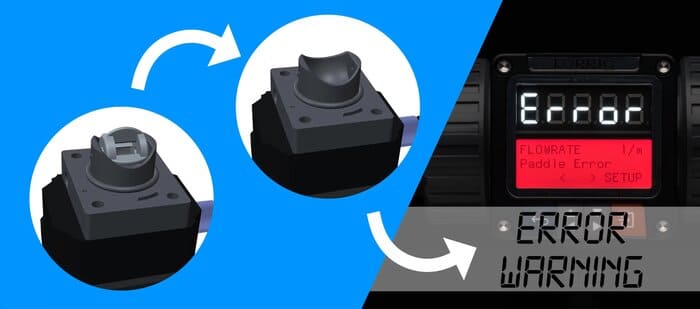
*The impeller anomaly warning function is intended only to assist onsite personnel in accelerating the diagnosis of equipment malfunctions. Due to unpredictable environmental factors and magnetic interference from nearby equipment, this function may fail. Do not rely on this function as the sole source of critical or safety-related signals. For troubleshooting, please contact LORRIC for further assistance.

➤ Bidirectional Flow Detection Capability
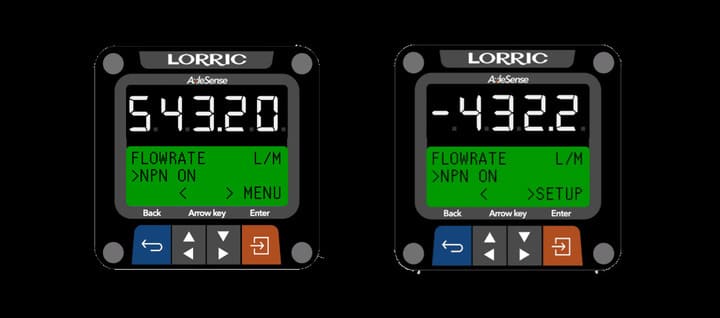
 Bidirectional Flow Detection Capability

2 ) AxleSense VS. Competitor

Product AxleSense Normal Paddlewheel flow meter
Two-directional flow detection Yes  No
Response signal Dense
Large intervals
Paddlewheel weight Even
Uneven
Screen indicator lights A colored trio of alarm indicator lights: green, orange, red No specialized colors
Screen display LED-5 digits LED/LCD- 16x3 LCD backlight display LCD Only
Measuring range Low speeds measurable, wider range Low speeds are hard to measure, narrower range
Measuring margin of error Low error at high speed and small error at low speed Low error at high speed and large error at low speed
Productos que también pueden interesarte
Artículos relacionados

Contáctanos